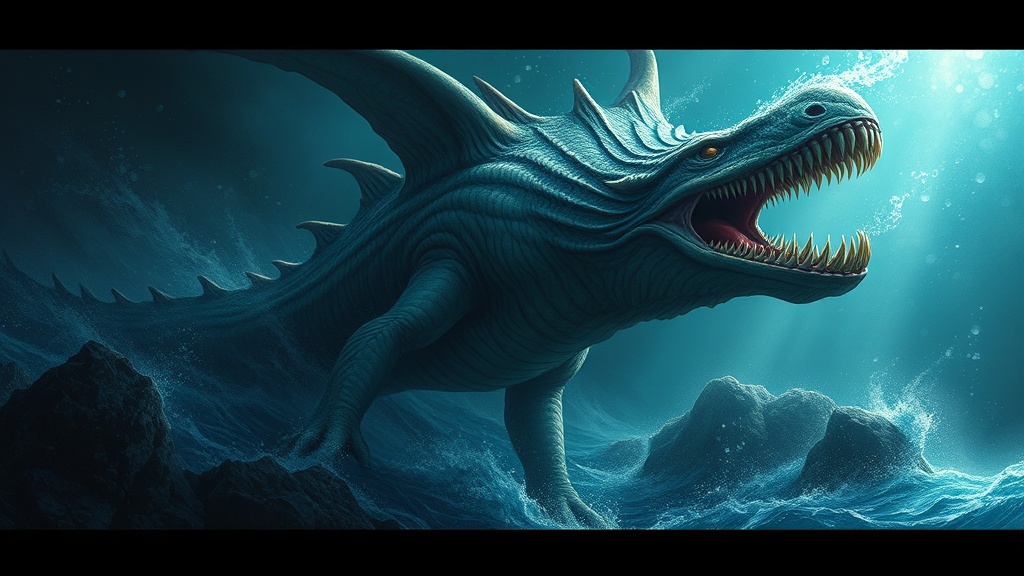
Tracing the Evolution of Sea Monster Illustrations

In the 16th century, a single error in a ship's log or a misunderstood sighting could lead to a map being marked with a "Kraken" for decades. This post examines how sea monster illustrations evolved from terrifying warnings of the unknown into decorative artistic flourishes on vintage maps. We'll look at the shift from scientific observation to mythological decoration and how these illustrations impact the value of a collector's piece today.
Why Did Ancient Cartographers Include Sea Monsters?
Cartographers included sea monsters primarily to fill "horror vacui"—the fear of empty spaces—and to warn sailors of perceived dangers in uncharted waters. During the Age of Discovery, the ocean wasn't just a body of water; it was a void filled with potential threats. If a mapmaker didn't know what was in a specific patch of the Atlantic, they often filled it with a Leviathan or a giant serpent to signify that the area was dangerous or unexplored.
It wasn't just about fear, though. It was about branding. A map with a fierce sea serpent looked more "complete" to a buyer than a map with a blank ocean. These creatures served as visual placeholders. They also helped communicate the psychological state of the era—a time when the line between science and myth was incredibly thin.
Think about the scale of these creatures. We aren't talking about a simple fish. We're talking about creatures that could swallow a caravel whole. This level of detail is what makes modern collectors hunt for these specific prints.
The evolution of these creatures follows a specific pattern:
- The Warning Era: Monsters are depicted as genuine threats to navigation.
- The Decorative Era: Monsters become more stylized, often used to frame the map or fill corners.
- The Scientific Era: As maritime technology improved, sea monsters were replaced by accurate bathymetric data and depth markings.
The transition from a "monster" to a "decoration" is a key marker for collectors. If you see a map where the creature looks almost too perfect or symmetrical, it might be from a later period where the art was more important than the "danger" it represented.
How Can You Identify Different Types of Sea Monsters on Maps?
You can identify different types of sea monsters by looking for specific anatomical features like scales, fins, and the presence of mammalian or reptilian traits. Most sea monsters on vintage maps fall into three distinct categories: the serpent, the beast, and the hybrid.
First, you have the Great Serpents. These are long, winding bodies, often resembling eels or snakes, but with exaggerated fins or even wings. You'll see these frequently in 16th-century sea monster illustrations. They represent the most primitive form of the "unknown."
Next are the Hybrid Beasts. These are much more complex. They might have the head of a lion, the body of a fish, and the tentacles of a squid. These were often used to represent the "weirdness" of the deep. The detail in these hybrids is often what drives up the price for collectors. If the engraving is crisp and the hybrid features are distinct, the value usually climbs.
Finally, there are the Whale-like Leviathans. These are larger, more massive creatures that look like a cross between a whale and a dragon. They were often used to fill large expanses of the Pacific or Atlantic oceans. They feel more "solid" and grounded in reality than the more fantastical serpents.
A quick tip for collectors: Always check the engraving depth. A high-quality copperplate engraving will show much more "muscle" and texture in a sea monster than a cheaper, later lithograph. If the lines look soft or blurry, you're likely looking at a much later reproduction. To ensure you're seeing the real deal, you might want to practice identifying printing techniques in antique maps.
| Monster Type | Common Features | Typical Era |
|---|---|---|
| Serpent | Long, sinuous body, minimal limbs, fins | Early 1500s |
| Hybrid | Mix of mammalian/reptilian/fish parts | Late 1500s - 1600s |
| Leviathan | Massive, heavy body, whale-like | 1600s - 1700s |
What Makes a Sea Monster Map More Valuable?
The value of a map featuring sea monsters is driven by the rarity of the engraving, the condition of the paper, and the artistic complexity of the creature itself. A map with a generic, small fish in the corner won't command the same price as a map featuring a massive, intricately engraved Kraken or a multi-headed sea serpent.
There are a few things that drive the price up. First, the "Artistic Intent." If the monster is a central part of the map's composition—rather than just a tiny speck in a corner—it becomes a piece of art in its own right. Collectors love a map where the creature feels like a character. (I've seen auctions where a particularly well-drawn sea monster bumped the price by 20% compared to a standard version of the same map.)
Second, the "Era of Uncertainty." Maps from the late 1500s and early 1600s are the "sweet spot." This was the peak of the transition from the Renaissance to the scientific revolution. The monsters from this era are often more "organic" and less "cartoonish" than those found in the 18th century. This makes them more desirable for serious collectors.
Third, the "Condition of the Engraving." Because these maps are often printed on heavy, handmade paper, the way the ink sits in the grooves matters. If the ink is thick and the lines are sharp, the creature will pop off the page. This is a huge factor. If you're buying a map, you need to be careful about how the ink has aged. I've written about spotting authentic age on antique world maps, and it applies heavily to the fine-line detail of a sea monster's scales.
It's also worth noting that the "Scientific Accuracy" of the era plays a role. A map that shows a creature that looks somewhat like a real animal (like a giant squid or a whale) is often more valuable than a completely nonsensical monster. It shows the tension between what people saw and what they imagined.
One thing to watch out for is the "Reproduction Trap." Many modern companies produce high-quality reprints of famous maps, including those with sea monsters. These look great on a wall, but they don't hold the same value as an original. Always check the paper texture and look for the plate mark—the indentation left by the metal plate under pressure. If you don't see a plate mark, you're likely looking at a modern print.
If you're worried about the long-term storage of these pieces, remember that the ink and paper are delicate. I highly recommend reading my post on preserving your paper treasures from sunlight and humidity before you hang anything up. Those detailed sea monsters can fade if they aren't treated right.
The evolution of the sea monster is essentially a timeline of human knowledge. As we mapped the world, the monsters disappeared, replaced by the cold, hard facts of depth and distance. But for a collector, that disappearance is exactly what makes the original, "monstrous" versions so incredibly special.