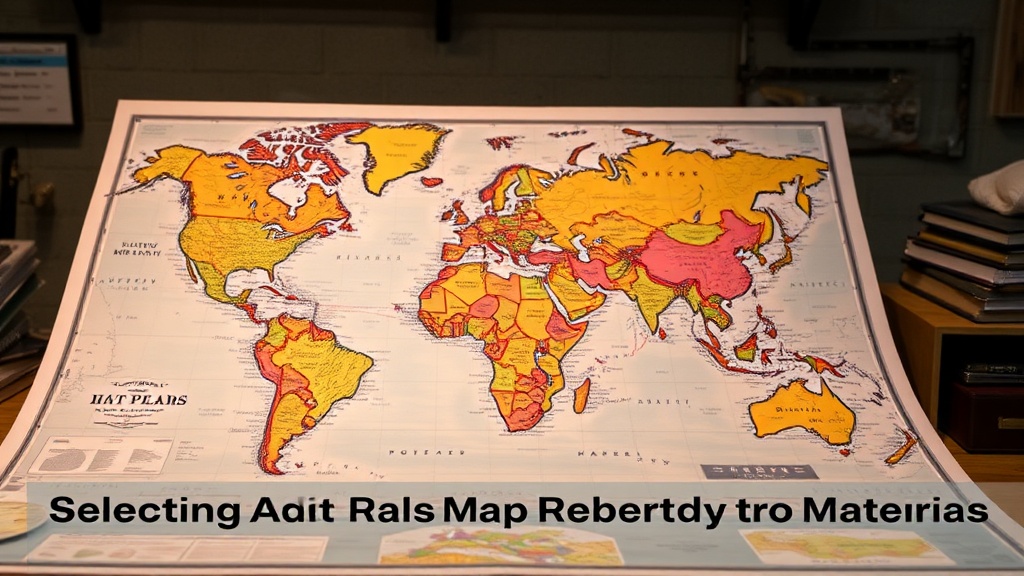
Selecting the Right Acid-Free Materials for Map Mounting

You’ve just acquired a stunning 19th-century hand-colored topographical map of the Canadian Rockies. It looks incredible, but you notice the edges are slightly brittle and there's a faint yellowish tint creeping in from the margins. If you decide to mount this piece for display, choosing the wrong backing or adhesive won't just ruin the look—it will physically degrade the paper through chemical reactions. This post explains how to identify and select the specific acid-free, lignin-free materials required to mount vintage maps without causing permanent damage.
Why Does Acid Content Matter for Vintage Paper?
Acid content matters because high acidity causes paper to become brittle and discolor over time through a process called acid hydrolysis. Most standard commercial papers and cheap cardboard backings contain lignin, a natural component in wood pulp that breaks down and creates acid. When you press a map against an acidic surface, that acid migrates into the map's fibers. This is why old newsprint turns brown and crumbles, while high-quality rag paper stays supple for centuries.
When you're working with a piece of history, you aren't just dealing with aesthetics. You're fighting chemistry. If you use a standard mounting board from a local craft store, you're essentially inviting a slow-motion disaster. The goal is to use materials that are chemically neutral or slightly alkaline to counteract the natural acidity of aging paper.
I've seen too many collectors try to save a bit of money by using standard mounting tape or cheap foam boards. It’s a mistake. The adhesive on a standard roll of Scotch tape or even many "artist" tapes will bleed oils and acids into the map within a few years. It’s a heartbreak to watch a map I've spent years tracking become a brittle, stained mess because of a $5 mistake.
To prevent this, look specifically for products labeled as "archival quality" or "acid-free." But be careful—the term "acid-free" is often used loosely in the retail world. You want to see documentation that mentions a pH-neutral rating. For a deep dive into how paper chemistry works, the Wikipedia entry on acid-free paper provides a solid technical foundation for understanding these molecular shifts.
What are the Best Materials for Map Mounting?
The best materials for mounting vintage maps are archival-grade linen, pH-neutral museum boards, and reversible, acid-free adhesives. You want materials that don't just stay neutral, but also allow for the map to be removed if necessary without tearing the fibers. This is a concept known as reversibility, and it's the gold standard in professional conservation.
Here is a breakdown of the most common professional-grade materials you should look for:
- Museum Board: This is a heavy, rigid board used as a backing. It must be 100% cotton rag or high-quality alpha-cellulose. Brands like Gaylord Archival are the industry standard for collectors.
- Linen/Linen Tape: For mounting the edges of a map, use a high-quality linen strip. This provides support without the rigidity that causes paper to crack.
- Wheat Starch Paste: This is a classic, reversible adhesive used by conservators. It is incredibly stable and can be easily "undone" with a bit of moisture if you ever need to remove the map.
- Methyl Cellulose: Often used as a thinner or an adhesive, it’s a safer, more modern alternative to many synthetic glues.
If you aren't ready to mix your own pastes, you can find pre-made archival adhesives. However, avoid any product that uses "permanent" in the description. If it's permanent, it's a red flag. If you can't undo it, you shouldn't be using it on a map you care about. It's that simple.
A quick comparison of common materials and their suitability for map mounting:
| Material Type | Standard/Retail Version | Archival/Museum Version | Verdict for Collectors |
|---|---|---|---|
| Backing Board | Foam Core (Standard) | Acid-Free Museum Board | Only use Museum Board |
| Adhesive | Glue Stick/Tape | Wheat Starch Paste | Avoid standard adhesives |
| Support | Cardstock | Linen/Cotton Rag | Linen is superior |
I often tell people that if you're spending hundreds of dollars on a map, don't spend five dollars on the mounting. It's a bad ratio. It's like buying a Ferrari and putting budget economy tires on it.
How Much Does Professional Mounting Cost?
The cost of professional mounting varies widely, typically ranging from $50 to over $500 depending on the size of the map and the complexity of the preservation required. While DIY-ing with archival materials is cheaper, professional conservation is an investment in the long-term survival of the piece.
If you decide to do it yourself, your costs will be front-loaded. You'll need to buy the specialized tools and materials upfront. A high-quality set of archival tools might cost you $100 to $200, but that kit will serve you for years. If you go to a professional framer, you're paying for their expertise and their liability. They know exactly how much tension a piece of 18th-century paper can take before it snaps.
If you're working with a particularly delicate or valuable piece—something with significant historical provenance—I strongly suggest looking into professional services. It's better to pay a professional now than to try and fix a mistake later. You can't "un-brown" a map once the acid has done its work. It’s a permanent change.
For those who are just starting out, I'd recommend following the advice in my previous post on how to start collecting vintage maps. It covers many of the foundational steps that lead up to the mounting phase. Getting the collection right from the beginning saves you a lot of headaches down the road.
One thing to keep in mind: even with the best materials, environmental factors still play a role. Even a perfectly mounted map will degrade if it's sitting in a room with high humidity or direct sunlight. You might want to read more about preserving your paper treasures from sunlight and humidity to ensure your mounting efforts aren't wasted by poor storage conditions.
When you're selecting your materials, always check the manufacturer's specifications. If a company like University Products or Talas sells a product, they will usually provide a detailed breakdown of the chemical properties. If the website is vague about the pH level or the presence of lignin, walk away. You need certainty, not "close enough."
It's easy to get overwhelmed by the technical jargon. pH levels, lignin-free, alpha-cellulose, reversible adhesives—it's a lot. But at the end of the day, the goal is simple: use materials that don't react with the paper. If the material is inert and neutral, you're usually on the right track.
Don't forget that the mounting process is also about structural integrity. A map shouldn't be under tension. If you mount a map too tightly to a rigid board, the paper might expand and contract with the weather, causing it to buckle or even tear. This is why many collectors prefer "hinging" a map to a backing rather than gluing it down entirely. It allows the paper to "breathe" slightly.
I remember a client who brought in a beautiful 1850s nautical chart that had been mounted with standard double-sided tape. The tape had actually eaten through the paper in several places, leaving permanent gaps. It was a preventable tragedy. Use the right stuff the first time.
If you're feeling nervous about the process, start small. Practice your mounting techniques on some scrap pieces of old, low-value paper. See how the adhesive reacts, how the board holds the weight, and how the materials behave together. This builds confidence before you touch your prize pieces.
The more you learn about the physical properties of your collection, the better your stewardship becomes. A map isn't just a piece of paper; it's a snapshot of a moment in time. Treat it with the respect its history deserves.
Steps
- 1
Identify the Paper Type
- 2
Select Acid-Free Matting
- 3
Choose Archival Adhesives
- 4
Inspect the Glass Type