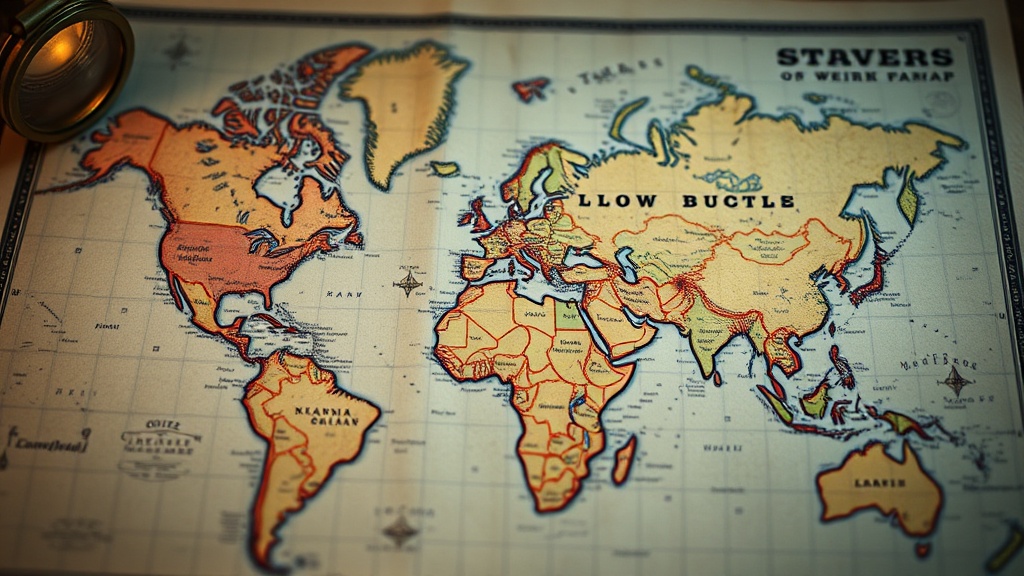
Vintage Map Collecting: A Beginner's Guide to Cartographic Treasures

Vintage map collecting offers a unique window into history, geography, and art—all in one tangible artifact. This guide covers everything needed to start building a meaningful collection: understanding what makes maps valuable, where to find authentic pieces, how to evaluate condition, and how to care for acquisitions. Whether drawn to the hand-colored coastlines of 19th-century atlases or the bold graphics of mid-century road maps, you'll find practical steps to begin (and grow) a collection that brings genuine satisfaction.
What Makes Vintage Maps Valuable to Collectors?
The value of a vintage map depends on several interconnected factors. Age matters, certainly, but rarity and condition often carry more weight than a date alone.
First editions—especially the first states of copperplate engravings—command premium prices. When an error gets corrected in subsequent printings (a misplaced island, a misspelled explorer's name), those early "mistake" versions become highly sought after. The Library of Congress Rare Maps collection documents many such variations.
Condition follows established gradings: mint (perfect), excellent (minor flaws), very good (visible but not distracting wear), good (complete but showing age), and fair (significant issues). Maps that have been hand-colored by contemporary artists—rather than modern hand-coloring added to boost appeal—hold substantially more value. Look for period watercolors that have mellowed with age, not the garish, saturated hues of recent over-painting.
Subject matter drives niche markets. City plans, celestial charts, battle maps, and colonial America each attract dedicated collectors. A 1750 map of a small English county might fetch modest sums, while the same era's map of New Amsterdam (early Manhattan) could command thousands. The decorative appeal—the ornate cartouches, sea monsters, compass roses—also influences desirability, particularly for collectors who frame and display their pieces.
Where Should Beginners Look for Authentic Vintage Maps?
Reputable sources exist at every price point, from estate sales to specialized dealers. The key is knowing what to expect from each channel.
Antique map dealers offer expertise and guarantees of authenticity. Established sellers like Barry Lawrence Ruderman Antique Maps or the Antiquarian Booksellers' Association of America members provide detailed condition reports and provenance documentation. You'll pay a premium—often 20-40% above auction prices—but gain peace of mind.
Auction houses (both brick-and-mortar and online) present opportunities for sharper pricing. Bonhams, Christie's, and Swann Galleries regularly feature map lots. The catch? Condition assessments may be limited, and buyer's premiums add 15-25% to the hammer price. Swann's annual Printed & Manuscript Americana sales consistently include cartographic material worth watching.
Book fairs and antique shows allow physical inspection—critical for evaluating paper quality, foxing (those brown age spots), and coloring. The Miami International Map Fair and the London Map Fair (held at the Royal Geographical Society) are calendar highlights for serious collectors.
Estate sales and flea markets occasionally yield treasures at fraction-of-value pricing. Worth noting: most sellers at these venues aren't map specialists. A $5 find in a cardboard box happens, but so do disastrous purchases of reproductions sold as originals. Bring a loupe (10x magnification) to examine printing methods—genuine copperplate engravings show plate marks and raised ink lines distinct from flat photomechanical reproductions.
| Source | Price Range | Expertise Available | Best For |
|---|---|---|---|
| Specialized Dealers | $$$ - $$$$ | Extensive | High-value acquisitions, beginners seeking guidance |
| Major Auction Houses | $$ - $$$$ | Moderate | Established collectors, investment-grade pieces |
| Book Fairs | $ - $$$ | Varies | Hands-on learning, mid-range purchases |
| Estate Sales/Flea Markets | $ - $$ | Minimal | Budget hunters, experienced authenticators |
| Online Marketplaces (eBay, AbeBooks) | $ - $$$ | Unreliable | Common maps, price research |
How Can You Tell If a Vintage Map Is Authentic?
Authentication requires examining paper, printing technique, and aging characteristics. Here's the thing: fakes and reproductions have flooded the market, particularly for "decorative" antique-style maps sold to interior designers.
Paper examination—hold the map to light. Pre-1800 paper often shows chain lines (vertical wires in the paper mold) and wire marks. Most 19th-century paper is wove (smooth, without chain lines). Modern paper fluoresces brightly under UV light; old paper remains relatively dull. The "burn test" (touching a thread pulled from the margin to flame) distinguishes cotton/linen rag paper (old, burns to ash) from wood pulp (modern, smells chemical).
Printing methods reveal era and authenticity. Copperplate engravings (dominant 1500s-1820s) show characteristic plate marks—indentations where the press squeezed paper into the engraved plate. Lines are sharp, with slight raised ink you can feel. Lithography (popular 1820s-1900) produces flatter, more tonal images. Photomechanical processes (late 1800s onward) create dot patterns visible under magnification—dead giveaways for reproductions masquerading as old maps.
Aging signs shouldn't be uniform. Genuine foxing appears irregular and often follows the grain of the paper. Artificial aging—tea staining, chemical treatments—looks too even, too deliberate. Old fold lines show wear; artificially creased paper cracks differently.
Reference works help immensely. Philip Burden's The Mapping of North America (for 1500-1700 coverage), R.V. Tooley's Maps and Map-Makers, and Rodney Shirley's Atlases in the British Library provide detailed descriptions of legitimate issues. When a seller can't (or won't) identify which plate state a map represents, proceed with caution.
Common Red Flags in Map Authentication
- Modern margins added to old map images
- Printing on thick, bright white paper
- Perfect, uniform coloring with no variation
- "Old" maps sold in standard frame sizes from big-box retailers
- Seller unable to identify the cartographer or publication date
- Price too good for the apparent rarity (that $20 "1600s" map of the world)
What Types of Maps Should Beginners Collect?
Start with what genuinely interests you—collections built on passion outlast those built purely for investment. That said, some categories offer better entry points than others.
19th-century atlas maps represent the sweet spot for beginners. They're genuinely old, often beautifully hand-colored, and widely available at $50-$300. Publishers like John Tallis, Samuel Augustus Mitchell, and Joseph Hutchins Colton produced thousands of atlases; individual plates regularly appear at accessible prices. Avoid the common pitfall of buying " Atlas"—loose maps removed from broken books—without confirming they weren't trimmed to remove binding damage.
Mid-century road maps (1930s-1960s) appeal to automotive history enthusiasts and graphic design lovers. Companies like Rand McNally, H.M. Gousha, and General Drafting produced millions; the illustrated covers featuring simplified cars and optimistic landscapes have collectible value themselves. Condition matters less here—it's an affordable category where you can collect freely without catastrophic financial risk.
Topographical survey maps from government agencies (USGS in America, Ordnance Survey in Britain) document changing landscapes at modest cost. Early 20th-century USGS quadrangles, with their distinctive green contours and red property lines, record pre-suburban America. They're historically significant, scientifically rigorous, and often cost under $30.
Celestial maps—star charts and planispheres—combine scientific illustration with decorative appeal. Andreas Cellarius's Harmonia Macrocosmica (1660) plates are museum-quality investments, but 19th-century educational star charts by Asa Smith or Elijah Burritt offer accessible alternatives. The constellations appear as mythological figures, animals, and scientific instruments—art and astronomy intertwined.
How Should You Store and Display Vintage Maps?
Proper preservation protects both value and appearance. Paper is surprisingly durable—but only when handled correctly.
Storage means archival materials, period. Acid-free folders, polyester film sleeves (Mylar D or Melinex 516), and archival boxes prevent the yellowing and embrittlement that ruin collections. Store flat when possible; rolling causes stress at the curl. If you must roll, use large-diameter tubes (minimum 4-inch diameter) with acid-free tissue interleaving. Never store in attics, basements, or near heating vents—stable 65-70°F with 30-50% relative humidity is ideal.
Display requires UV-filtering glass or acrylic. Regular window glass blocks some UV, but not enough—maps fade dramatically in direct or even bright indirect light. Museum-quality glazing (Tru Vue Conservation Clear or equivalent) combined with matting that keeps the map surface from contacting the glass prevents condensation damage. The catch? Professional framing for a large map runs $200-500. Budget alternatives include archival sleeves stored in albums or flat files, with occasional rotation of displayed pieces.
Cleaning and repair—don't. Surface dirt can sometimes be gently brushed away with a soft document brush, but washing, bleaching, or tape removal requires professional paper conservators. The American Institute for Conservation maintains a find-a-conservator directory for serious restoration needs. Home repairs with Scotch tape or glue cause irreversible damage that slashes value.
Insurance deserves consideration once a collection exceeds a few thousand dollars in value. Standard homeowners policies often limit coverage on paper collectibles; riders or specialty collectibles policies provide better protection. Document your collection with photographs, purchase receipts, and professional appraisals for significant pieces.
Building a vintage map collection rewards patience more than deep pockets. Start with a single piece that speaks to you—a hometown from 1880, a country crossed during meaningful travels, a constellation visible from childhood summers. Learn its story. Handle it carefully. Display it proudly. Each map carries the accumulated decisions of cartographers, engravers, colorists, and the countless hands that unfolded it across centuries. You're not just collecting old paper; you're becoming part of that continuing story—another careful steward in a chain stretching back hundreds of years.