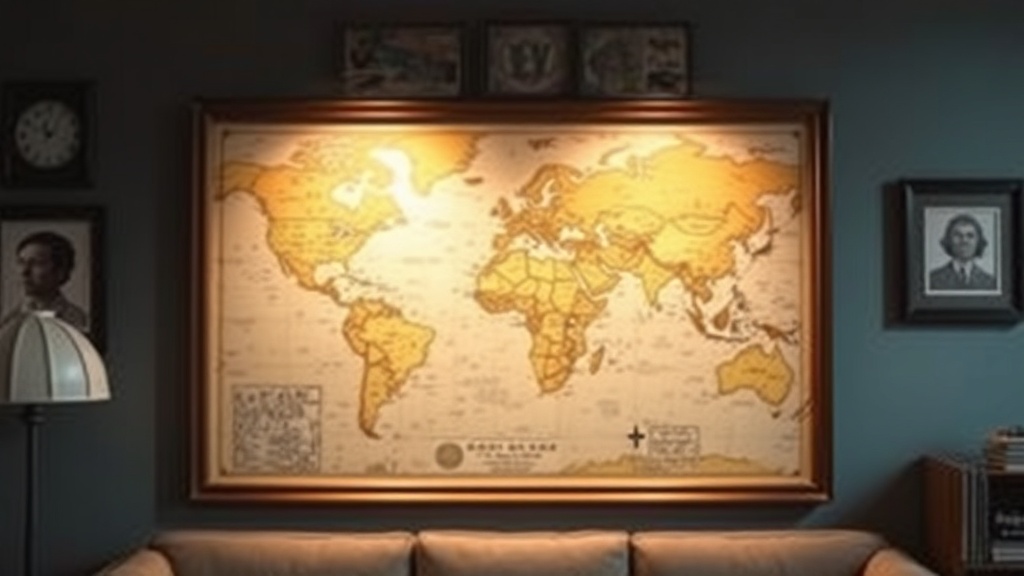
How to Properly Frame and Display Vintage Maps at Home

This guide covers everything from selecting archival materials to choosing the right wall placement for vintage maps. Whether you've inherited a 19th-century railroad survey or picked up a decorative atlas page at auction, proper framing protects your investment while turning these cartographic artifacts into striking home décor. You'll learn which materials won't damage delicate paper over time, how UV light silently destroys ink pigments, and why the hardware store frame special isn't always the bargain it appears to be.
What's the Best Way to Frame a Vintage Map Without Damaging It?
The best approach combines archival materials, minimal handling, and professional mounting techniques that never adhere directly to the map surface. Museum conservators follow a simple rule: anything touching the artifact must be reversible and chemically stable.
Start with the backing. Regular cardboard contains lignin — a wood byproduct that turns acidic over decades. Acid-free foam core or rag board (100% cotton, pH neutral) creates a stable foundation. For high-value pieces, consider 4-ply museum board from suppliers like University Products or Gaylord Archival.
Matting serves dual purposes. The window mat creates visual breathing room while keeping the map from contacting glass. Here's where many well-meaning collectors stumble: standard mat board has a pH around 4.5-5.5, meaning it's slightly acidic. Conservation-grade matting (pH 7.5-8.5, often labeled "rag" or "museum") costs roughly 40% more but prevents the yellowing and embrittlement that ruins paper artifacts.
The glazing decision matters more than most realize. Regular glass blocks roughly 45% of UV rays. Conservation Clear glass from Tru-Vue filters 99% of harmful light. Museum Glass adds anti-reflective coating — worth the premium for maps displayed in bright rooms. Acrylic options (like OP-3 from Lucite) work for oversized pieces where glass weight becomes dangerous.
| Glazing Type | UV Protection | Weight | Best For |
|---|---|---|---|
| Standard Glass | ~45% | Heavy | Short-term display, low-value pieces |
| Conservation Clear | 99% | Heavy | Valuable maps in controlled lighting |
| Museum Glass | 99% | Heavy | High-traffic areas with reflections |
| OP-3 Acrylic | 98% | Light | Maps over 30" in any dimension |
| Tru-Vue Optium Museum | 99% | Light | Museum-quality, anti-static, anti-reflective |
Hinging attaches the map to the backing without tape or glue. Japanese tissue paper and wheat starch paste — the same materials used in the Library of Congress conservation labs — create hinges that hold securely but release with water if removal becomes necessary. Never use masking tape, Scotch tape, or those handy adhesive photo corners sold at craft stores. The adhesive migrates through paper over 5-15 years, leaving permanent stains.
How Much Does Professional Map Framing Cost?
Professional framing for a standard 18x24 inch vintage map typically runs $200-$600 depending on materials, mat layers, and glazing choice. Custom framers charge by component: the frame moulding itself ($8-50 per foot), matting ($30-120), glazing ($40-200), and labor ($75-150).
The price escalates quickly with size. A 36x48 inch railroad map requires moulding by the foot, oversized mat boards (special order), and either heavy acrylic or joined glass. Expect $800-$1,500 for museum-quality treatment at this scale.
That said, some situations justify DIY approaches. Ready-made frames from Michaels' Gallery Collection or Framebridge work for decorative reproductions or maps with modest value (under $100 replacement cost). Buy the largest size that fits your map, then add custom-cut archival matting from suppliers like Matboard and More. You'll spend $60-$150 versus $300+ for fully custom.
Here's the thing: framers aren't created equal. Ask prospective shops three questions before committing:
- Do you use archival materials exclusively, or charge extra for conservation-grade?
- What's your hinging method for works on paper?
- Can you show examples of cartographic materials you've framed?
Shops that balk at these questions — or suggest dry-mounting (heat-activated adhesive) — should be avoided regardless of price. Dry-mounting is permanent. The adhesive never releases, meaning future conservators must scrape or solvent-treat the back of your map, inevitably causing damage.
Where to Find Qualified Framers
The Professional Picture Framers Association maintains a certification program (PPFA) requiring members to demonstrate knowledge of conservation techniques. Not every good framer pursues certification, but PPFA membership indicates serious commitment.
In major Canadian cities, established options include:
- Vancouver: Vancouver Art Gallery's framing service; Malaspina Printshop for works on paper
- Toronto: Bark Frameworks (high-end conservation); DeSerres locations with certified framers
- Montreal: Encadrement Denis Fréchette; Atelier Daniel
- Calgary: Masterpiece Framing; The Framing Depot (ask specifically for archival treatment)
Worth noting: many auction houses (Heritage Auctions, Swann Galleries) offer post-sale framing at reasonable rates. They understand the material and have relationships with conservators.
Where Should You Hang a Vintage Map in Your Home?
Location matters as much as materials. UV exposure, humidity fluctuations, and temperature swings degrade paper and pigments regardless of how well you've framed the piece. The ideal environment maintains 65°F temperature, 35% relative humidity, and minimal light exposure — essentially, a museum storage room. Your living room isn't that. Compromise intelligently.
Avoid exterior walls in older homes. They experience wider temperature swings than interior walls. North-facing walls receive indirect light, making them preferable to south-facing exposures that get blasted with UV for hours daily. Never hang valuable maps in bathrooms, kitchens, or unfinished basements — humidity spikes from showers, cooking, or seasonal groundwater create conditions where mold colonizes paper and foxing (those rust-brown spots) accelerates.
The catch? Maps look fantastic above fireplaces. The warm glow, the centered placement — it's aesthetically perfect. Conservation-wise, it's disastrous. Heat rises, creating a chimney effect that pulls moist air through the frame backing. Over five to ten years, you'll notice toning (browning) along the top margin, often called "mat burn" though it's actually environmental damage. If the fireplace wall is non-negotiable, install a picture light with UV-filtering LEDs and keep the map behind closed glass doors when not entertaining.
Consider rotation for extensive collections. Museums display works for 3-6 months, then return them to dark storage for years. You don't need to be that strict, but swapping maps seasonally protects them while keeping your décor fresh. Store rotated pieces flat in archival boxes (Gaylord's E-flute corrugated board boxes work well) in closets away from HVAC vents.
Lighting Strategies That Protect and Showcase
Direct sunlight destroys maps. Period. Fugitive pigments — the organic dyes in hand-colored engravings — fade dramatically within months of direct exposure. Even "lightfast" modern inks degrade; antique inks simply have less resistance.
LED picture lights with CRI (Color Rendering Index) above 90 accurately display colors while emitting negligible UV. Avoid halogen bulbs entirely — they're essentially heat sources that emit damaging radiation. Cocoweb and Concept Lighting manufacture LED picture lights specifically designed for art display.
Distance matters. Map surfaces should never feel warm to the touch. If you hold your hand against the glass and detect heat, the light source is too close or too intense. Six feet of separation between map surface and bulb minimum; twelve feet for high-wattage fixtures.
How Do You Clean and Maintain Framed Vintage Maps?
Maintenance is prevention, not intervention. Once framed properly with sealed backing (dust cover paper, not open framing), maps need minimal handling. Dust the glass with a microfiber cloth. Never spray cleaner directly onto the frame — liquid seeps into corners and wicks under glazing through capillary action.
Inspect annually. Check the backing paper for tears (entry points for insects). Look for new foxing spots, which appear as small brown dots and indicate humidity problems. If you spot changes, unframe the piece — carefully — and consult a paper conservator before the damage spreads.
Insect infestation requires immediate action. Silverfish and booklice feed on cellulose and the animal glue in older sizing. If you see tiny black specks (frass) or the insects themselves, isolate the map in a sealed plastic bag and contact a conservator. Freezing works for some infestations (seal in plastic, freeze at -20°C for 72 hours, let return to room temperature while still sealed to prevent condensation), but professional treatment ensures complete eradication without thermal shock to brittle paper.
Handling Unframed Maps
Never roll antique maps tightly. The inner surface compresses; the outer surface stretches. Over decades, this creates permanent cracking along fold lines. Store flat when possible. If rolling is unavoidable for large items — wall maps, coastal surveys — use a tube at least 4 inches in diameter, with archival tissue interleaving to prevent surface abrasion.
Wash hands before handling. The oils and acids in skin permanently stain paper. Better yet, wear nitrile gloves (cotton gloves can snag on brittle edges). Support the map fully — don't grab corners or let it drape over table edges. These sound like small details. They're not. Every handling event carries risk; minimizing that risk preserves value and appearance for the next generation of collectors.
Ultimately, framing vintage maps balances aesthetic presentation against long-term preservation. The "right" approach depends on the map's value, rarity, and your personal relationship to the piece. A $40 decorative reproduction deserves different treatment than a first-state Ortelius. Know what you own — or consult a dealer who does — before making irreversible decisions. The map has survived decades or centuries already. Your job is ensuring it survives the next chapter in its story.
Steps
- 1
Choose archival-quality materials for framing
- 2
Select the perfect location with proper lighting
- 3
Mount and hang your vintage map securely