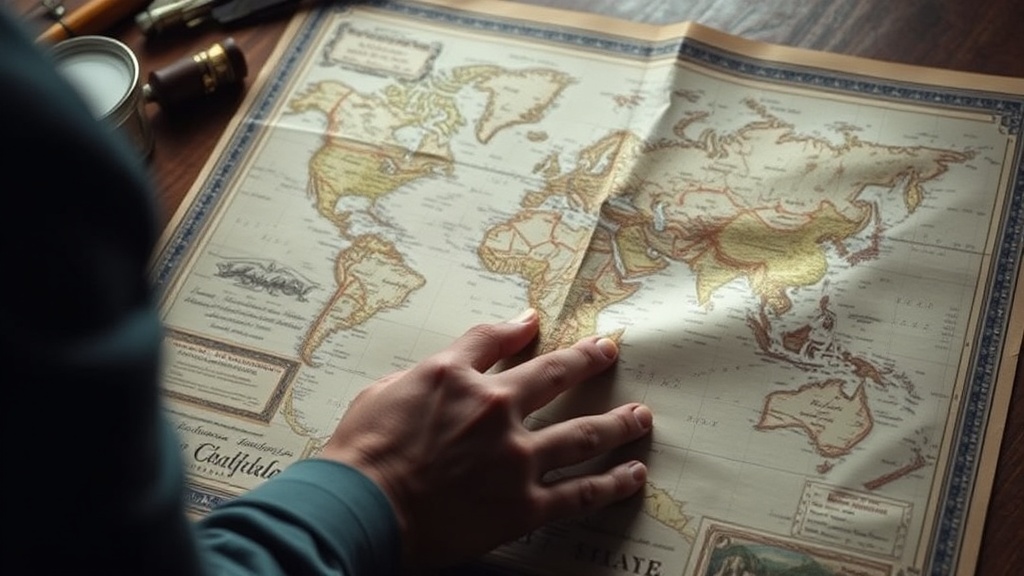
How to Flatten and Restore Folded Antique Maps Without Damage

Unfolding an antique map that's been stored folded for decades feels like opening a time capsule — but one wrong move and centuries of history can tear in your hands. This guide covers proven techniques to safely flatten creased maps, remove acidity buildup, and restore structural integrity without causing permanent damage. Whether you've inherited a family atlas or picked up a rare 19th-century survey map at auction, these methods will help preserve both value and historical authenticity.
What's the safest way to humidify a folded map before flattening?
Controlled humidity is the first step. Dry paper fibers become brittle — forcing them flat causes splits along fold lines. The goal is raising moisture content to approximately 7-10% so fibers relax without encouraging mold growth.
Here's the thing: you're not soaking anything. Professional conservators use humidity chambers — essentially sealed containers where distilled water evaporates slowly around (but never touching) the map. For home collectors, a clean bathroom with the shower running hot for ten minutes works surprisingly well. Wait until steam settles — you want moist air, not dripping walls.
Place the map on a clean, dry surface inside this humid environment. Check progress every 15 minutes. The paper should feel slightly cool and flexible — not damp. For heavily sized maps (the kind with that stiff, almost cardboard feel), expect 45 minutes to an hour. Laid paper — common in pre-1800s maps — responds faster, sometimes 20-30 minutes.
The catch? Too much humidity activates old adhesive residues. Many antique maps have tape repairs from the 1950s-70s. Once humid, that yellowed cellophane tape becomes gummy and can stain permanently. Check edges and verso (back side) for previous repairs before starting.
Worth noting: The Library of Congress Preservation Directorate recommends never exceeding 65% relative humidity during treatment. A simple hygrometer (the ThermoPro TP50 runs about $10) helps monitor conditions.
Can you iron an antique map to remove creases?
No — direct heat destroys paper fibers and can fuse old sizing agents to the iron. But carefully applied weight and moisture? That works. Think pressing, not ironing.
After humidification, place the map between sheets of unprinted newsprint or archival blotting paper. Plain copy paper contains optical brighteners that can transfer — don't use it. The Gaylord Archival supply company sells proper blotting paper in bulk, though clean, unprinted newsprint from a local printer (ask for "end rolls") works on a budget.
Layer your sandwich carefully:
- Hard, flat surface (glass, acrylic, or sealed MDF — never raw wood)
- Polyester web or silk screening (prevents sticking)
- Blotting paper
- The humidified map, unfolded as flat as possible
- Blotting paper
- Another polyester barrier
- Heavy weight — lead weights, textbooks in plastic bags, or purpose-built book presses
Leave it alone. Seriously. Check after 24 hours, replace damp blotting paper if needed, and repeat. Some deeply creased military maps need three or four cycles. Patience beats power — always.
That said, some creases won't fully release. Fold "memory" is real. A 150-year-old map folded the same way for a century retains that curve even after pressing. Don't force it. Gentle coaxing over weeks beats aggressive flattening that cracks the sheet.
How do you remove brown stains and foxing from old maps?
Oxidation stains — those rusty brown spots called "foxing" — are paper's natural enemy. They're caused by iron impurities in the pulp reacting with humidity over decades. Light foxing (few scattered spots) often responds to surface treatment. Heavy staining requires professional intervention.
For surface foxing, try a soft white vinyl eraser. The Staedtler Mars Plastic eraser is the gold standard — no colored erasers, no gritty "art gum" types. Work gently in one direction, eraser crumbs lifting surface dirt and light oxidation. Stop immediately if paper fibers start lifting or color transfers to the eraser.
Wet cleaning? It's possible — but risky. A 50/50 solution of distilled water and ethyl alcohol (99% pure, from a pharmacy or chemical supply) can lift some stains. Apply with a natural sponge, barely damp, working from the center outward. Never rub — dab and lift. The map must be fully supported on polyester webbing throughout.
| Treatment Method | Best For | Risk Level | Cost Estimate |
|---|---|---|---|
| Dry brushing / erasing | Surface dirt, light foxing | Low | $5-15 for supplies |
| Localized humidification | Sharp creases, small tears | Medium | $20-50 for setup |
| Wet cleaning (DIY) | Heavy surface grime | High | $30-60 for chemicals |
| Professional conservation | Valuable pieces, mold, major damage | Low (in expert hands) | $200-800+ depending on size |
The American Institute for Conservation maintains a directory of certified conservators. For maps worth over $500 or anything with historical significance, professional treatment isn't just recommended — it's malpractice to DIY.
What materials should you use for long-term map storage?
Flattening means nothing if storage undoes the work. Archival-quality materials aren't marketing fluff — they're chemically stable buffers between your map and the environment.
Polyester film sleeves (Mylar D or Melinex 516) are standard for single-sheet maps. They're inert, transparent for viewing without handling, and rigid enough to prevent re-creasing. The University Products catalog offers these in standard map sizes — or cut custom sheets from rolls. Avoid PVC "clear sleeves" from office supply stores — the plasticizers off-gas and yellow paper within years.
For oversized maps (wall-sized survey sheets, broadside nautical charts), flat storage is ideal but impractical for most collectors. The compromise? Roll storage — but properly. Use acid-free tube stock (3-4 inch diameter minimum) with unbuffered tissue interleaving. Never rubber bands — they fossilize into the paper. Cotton tying tape or unbleached twill works.
Here's the thing about flat files: they're expensive. A brand-new five-drawer flat file from Safco runs $800-1200. But used architect filing cabinets appear constantly on Craigslist and Facebook Marketplace in major cities — often $100-200. Calgary, Toronto, Vancouver — check weekly. Just verify drawers are clean, rust-free, and fully extend.
Creating a microclimate
Maps hate change. Temperature and humidity swings cause expansion and contraction — that's how fresh cracks form in previously stable paper. Ideal storage maintains 65°F (18°C) and 50% relative humidity year-round. Most homes fluctuate between 30% winter and 70% summer — brutal on paper.
Short of installing museum-grade climate control, silica gel canisters in storage boxes help buffer humidity swings. The indicating type (blue when dry, pink when saturated) can be recharged in a 250°F oven. Replace or recharge quarterly — mark your calendar.
Light exposure considerations
UV light fades hand-coloring faster than you'd think. A map displayed in average room light shows noticeable fading in 5-10 years. Museum glass with 99% UV filtering (Tru Vue Conservation Clear, for example) helps, but rotation is smarter — display for six months, store for six years.
When should you leave a map alone?
Not every problem needs solving. Some condition issues are stable — disturbing them creates active deterioration. Wax seals, original owner inscriptions, and period repair tapes are part of a map's history. Removing them (even the ugly ones) destroys provenance and often damages the sheet beneath.
Tears along original fold lines? Very common, often stable for decades. A tiny strip of Japanese kozo tissue and wheat starch paste (reversible, archival) can stabilize without visual intrusion. But if the map is rare, valuable, or historically significant, document the damage photographically and consult a conservator before touching anything.
Worth noting: The "patina of age" isn't a flaw. Slight toning, minor edge wear, even well-established foxing — collectors expect this. A map that looks "too perfect" raises authenticity questions. Your goal isn't restoration to factory-new condition. It's stabilization, preservation, and respectful presentation of a historical artifact.
The best-preserved antique maps in private collections share one trait — their owners knew when to stop. Flatten carefully, store properly, and let these windows into the past continue telling their stories for generations to come.
Steps
- 1
Assess the Map's Condition and Prepare Your Workspace
- 2
Apply Controlled Humidity to Relax the Paper Fibers
- 3
Press Between Acid-Free Materials with Even Weight Distribution