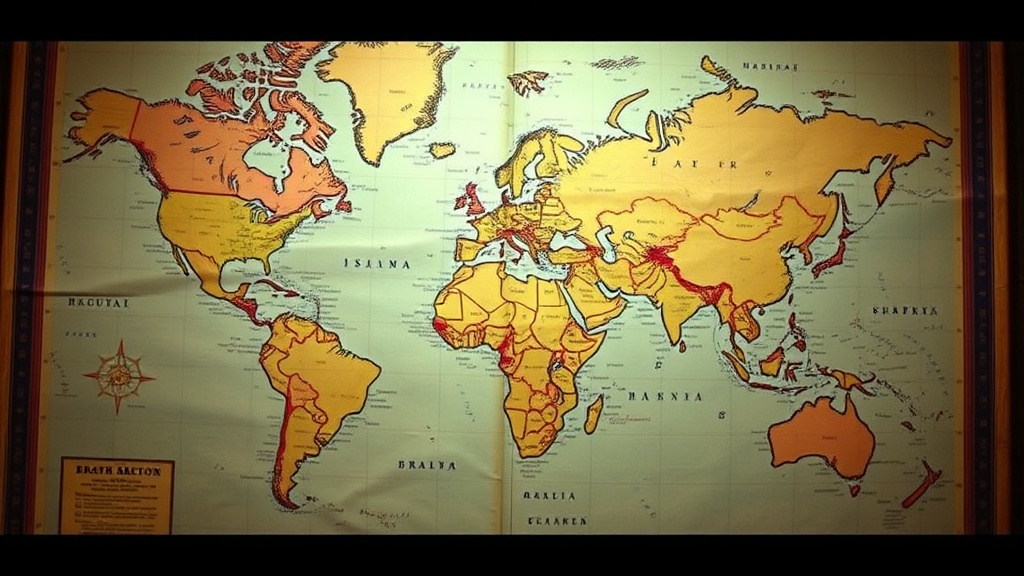
A Collector's Guide to Finding Authentic Vintage Maps

Vintage maps represent more than decorative pieces—they're tangible windows into how humanity understood (and misunderstood) the world centuries ago. Whether you're drawn to ornate 17th-century Dutch cartography, WWII-era military charts, or mid-century road atlases, this guide covers exactly what to look for when building a collection. You'll learn how to spot authentic originals versus reproductions, where to buy with confidence, and which details separate a $50 curiosity from a $5,000 investment piece.
What Makes a Vintage Map Valuable?
Authenticity and condition drive value—but there's more to the story. Age alone doesn't guarantee worth. A crumbling 18th-century map with significant damage might fetch less than a pristine 1920s National Geographic supplement in high demand.
The most sought-after maps share specific traits. Rarity matters—a single printing of a surveyor's chart from a small town in 1890 beats mass-produced school atlases. Historical significance adds premium. Maps documenting major events—the Louisiana Purchase, the opening of the Suez Canal, the first accurate Pacific surveys—command attention.
Artistic merit shouldn't be underestimated. Hand-colored copperplate engravings from firms like Blaeu, Hondius, or Ortelius aren't just documents; they're frame-worthy art. The decorative cartouches, sea monsters, and compass roses that collectors covet today weren't whimsy—they reflected genuine gaps in geographic knowledge.
Provenance helps too. A map with documented ownership history, especially from notable collections or institutions, carries added confidence. Paper quality reveals age—laid paper with chain lines (visible when held to light) indicates pre-19th-century production. Later machine-made paper has uniform texture without those characteristic wire marks.
How Can You Tell If a Vintage Map Is Original?
Authentic vintage maps show specific physical characteristics that reproductions rarely replicate perfectly. Start with the paper. Genuine antique paper feels different—thicker, often with irregular edges, and frequently showing age toning (that subtle yellow-brown patina that develops over centuries, not months).
Check the plate mark. Copperplate engravings were printed under tremendous pressure, leaving a distinct indentation around the image. Modern photomechanical reproductions lack this telltale ridge. Run your finger along the margin—if you feel a slight depression surrounding the map itself, that's a good sign.
Examine the color application. Authentic hand-coloring shows variation. The colorist's brushstrokes might extend slightly beyond borders. Colors vary between copies. Modern reproductions use uniform lithographic or digital color that looks flat and identical across prints.
The watermark test matters. Hold the paper to bright light. Genuine antique paper often bears watermarks—faint designs visible in the paper pulp itself. These might include manufacturer names, dates, or symbols. Reproductions printed on modern paper won't have period-appropriate watermarks (or any at all).
Print method identification helps too. Look closely at lines under magnification. Copperplate engraving shows slightly raised ink with crisp, uniform lines. Lithography (common from the 1820s onward) creates flatter, more tonal images. Modern inkjet or laser prints reveal dot patterns or toner particles completely foreign to historical production methods.
Where Should You Buy Authentic Vintage Maps?
Established dealers, auction houses, and specialized fairs offer the safest entry points—though each comes with different price expectations and expertise requirements. Here's the breakdown:
| Source | Price Range | Expertise Level | Best For |
|---|---|---|---|
| Specialized dealers (Barry Lawrence Ruderman, The Old Print Shop) | $200–$10,000+ | High—professional authentication included | Serious collectors, investment pieces, rare items |
| Auction houses (Swann Galleries, Christie's, Bonhams) | $100–$50,000+ | Moderate—condition reports provided, research required | Competitive pricing on mid-to-high-end pieces |
| Antique map fairs (London Map Fair, Miami International Map Fair) | $50–$5,000 | Varies—direct dealer interaction | Building relationships, seeing pieces in person |
| Reputable online marketplaces (AbeBooks, Vialibri) | $25–$2,000 | Low—buyer must verify authenticity | Budget-friendly entry, common editions |
| Estate sales and flea markets | $5–$500 | Very low—caveat emptor | Treasure hunting, potential bargains |
Dealers like Barry Lawrence Ruderman Antique Maps have built decades-long reputations on authenticity guarantees. The catch? You'll pay premium prices—sometimes 50-100% above auction results. For serious collectors, that premium buys peace of mind and often superior condition.
Auction houses offer another reliable channel. Swann Galleries in New York holds regular Maps & Atlases sales with detailed cataloging. Their condition reports and provenance research provide solid documentation. That said, buyer's premiums (typically 20-25%) add to final costs.
Online marketplaces require more caution. eBay has genuine sellers—but also countless reproductions listed as "vintage" or "antique style." The same applies to Etsy. If a deal looks too good, it is. A genuine 17th-century Blaeu hemisphere map won't sell for $49 with free shipping.
What Are the Most Collectible Types of Vintage Maps?
Certain categories consistently attract collector interest and maintain strong markets. Understanding these specialties helps focus a collection—and budget.
World maps and hemispheres remain perennial favorites. The evolution from Ptolemaic projections (showing only known continents) to increasingly accurate global representations tracks the Age of Exploration. Ortelius's 1570 Theatrum Orbis Terrarum—the first modern atlas—contains world maps that serious collectors chase. Single sheets from this atlas in good condition routinely exceed $3,000.
Americana commands particular strength in the North American market. Early depictions of the colonies, westward expansion maps, and territorial surveys document a nation's growth. Lewis and Clark expedition maps, Civil War battle charts, and railroad survey maps all attract dedicated collectors. The 1836 Map of the United States by David H. Burr—showing the Republic of Texas as an independent nation—represents a historically significant piece worth $1,500–$4,000 depending on condition.
City plans and bird's-eye views offer accessible entry points. 19th-century lithographic views of American cities—produced by firms like Currier & Ives or Bachmann—combine cartographic accuracy with artistic appeal. These were often sold to proud residents and businesses, making them both historical documents and promotional art. A good bird's-eye view of a major city (Chicago, San Francisco, New York) in nice condition runs $300–$1,200.
Celestial and astronomical maps appeal to science-minded collectors. The grand star charts from Johann Bayer's Uranometria (1603) or Andreas Cellarius's Harmonia Macrocosmica (1660) feature elaborate constellation figures against deep blue backgrounds. These blend scientific precision with Baroque artistry. Individual plates from Cellarius's atlas can command $2,000–$8,000.
Sea charts and portolan atlases served practical navigation needs—and now attract maritime history enthusiasts. The Dutch Golden Age produced extraordinary sea atlases. Willem Blaeu's Zeespiegel (Sea Mirror) or Jansson's sea charts show detailed coastlines, soundings, and rhumb lines. These often survived rough handling (they were working tools), making well-preserved examples genuinely rare.
How Should You Store and Display Vintage Maps?
Proper preservation protects both condition and value. Light damage is irreversible—UV exposure fades pigments and weakens paper fibers. Display framed pieces away from direct sunlight. If natural light is unavoidable, museum-grade UV-filtering glass (not standard "conservation" glass) provides genuine protection.
Humidity control matters enormously. Ideal storage conditions hover around 65°F and 50% relative humidity. Basements and attics are terrible choices—temperature fluctuations and moisture invite mold, foxing (those brown spots that plague old paper), and brittleness. A closet in a climate-controlled living space works better than fancy storage in hostile environments.
Unframed maps should lie flat in archival folders or storage boxes. Never roll valuable maps long-term—the curl becomes permanent and creates stress along the fold lines. If rolling is unavoidable for transport, use a wide-diameter tube (at least 4 inches) and interleave the map with acid-free tissue.
When framing, demand archival materials. Acid-free mat board (not "acid-neutral" or "buffered"—fully acid-free), cotton rag backing, and reversible mounting methods (hinges using Japanese paper and wheat starch paste, not dry-mounting or tape). Regular framers—even good ones—often lack conservation training. Seek out American Institute for Conservation (AIC) certified professionals for valuable pieces.
Handling protocol: Clean hands—or better, cotton gloves. Support the entire map when moving it. Never grab by edges or corners (they're the weakest points). Work on clean, padded surfaces. One careless moment with a torn fold line can destroy hundreds of dollars in value.
Worth noting: Insurance considerations. Standard homeowner's policies often cap collectibles coverage at inadequate levels. A dedicated collectibles rider or fine arts policy provides proper protection. Document your collection with photographs and appraisals. Major dealers like Neatline Antique Maps (part of the larger antique maps community) can provide valuations for insurance purposes.
The hunt for authentic vintage maps rewards patience, knowledge, and careful examination. Start modestly—a $100 19th-century county atlas page teaches you handling, storage, and research skills applicable to $5,000 acquisitions. Build relationships with reputable dealers. Study the references (Tooley's Dictionary of Mapmakers remains indispensable). Visit the fairs, handle pieces in person, develop your eye. The market has never been more accessible—nor more full of pitfalls for the unwary. Knowledge remains the ultimate currency in this field.